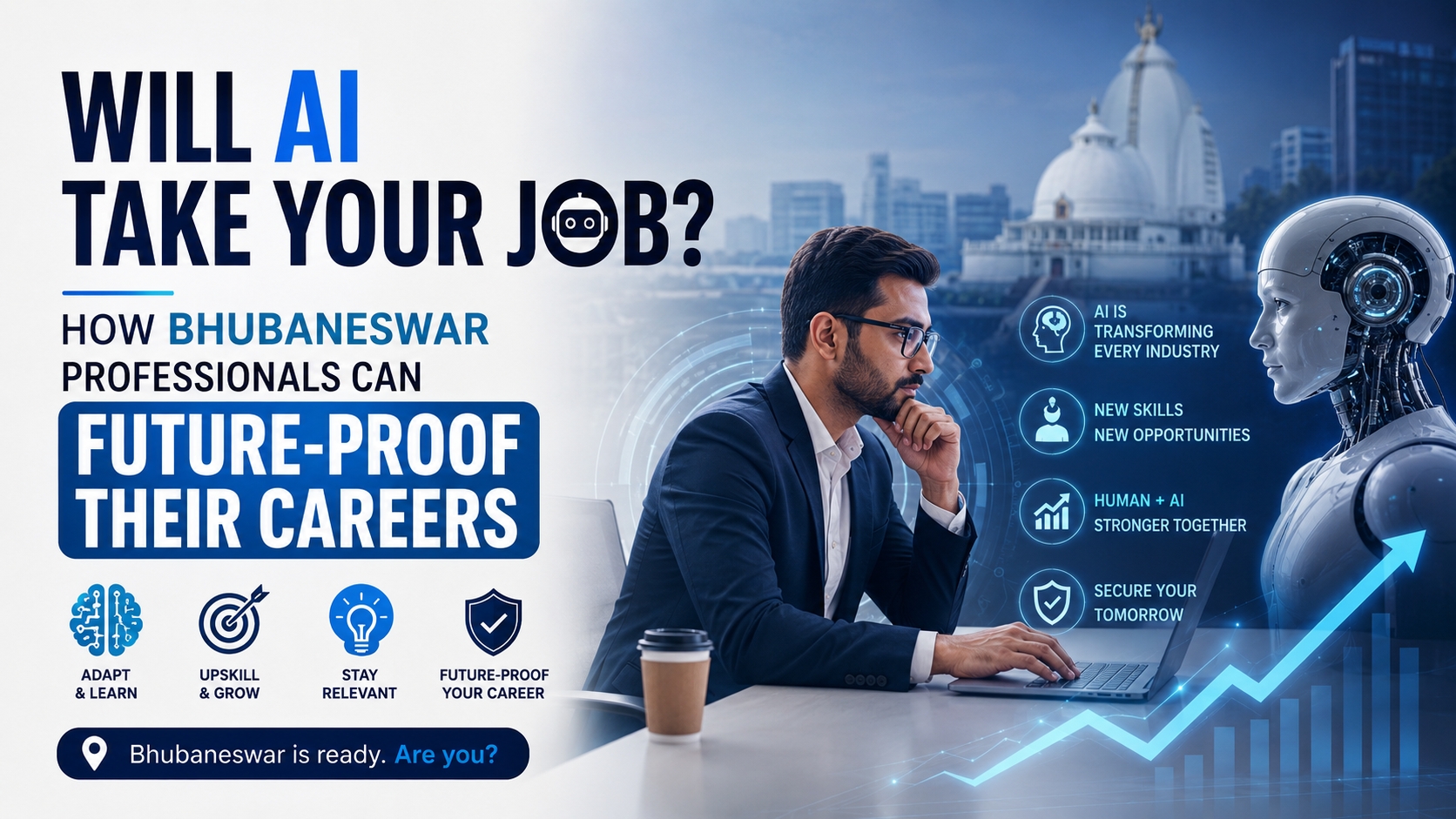
Will AI Take Your Job? How Bhubaneswar Professionals Can Future-Proof Their Careers
The question comes up in almost every conversation about work these days, usually with some version of quiet anxiety behind it: "Is AI going to take my job?" It's a fair question, and it deserves a more useful answer than the two extremes usually on offer — either blanket reassurance that "AI will never replace humans" or blanket panic that every job is about to disappear.
The honest answer is more specific than either of those. AI is not replacing jobs uniformly. It's replacing specific tasks within jobs, at different speeds, in different roles. Understanding that distinction is the single most useful thing a Bhubaneswar professional can do right now — because it changes the question from "will I lose my job" to "which parts of my job are changing, and am I adapting alongside them."
Why This Question Feels So Urgent Right Now
A few years ago, AI in the workplace mostly meant automation of repetitive, rules-based tasks — data entry, basic scheduling, simple customer queries. What's changed recently is that AI tools can now handle tasks that used to require genuine judgment: drafting documents, summarizing information, writing code, analyzing data, and even offering strategic recommendations.
This shift has moved AI from "something that affects factory workers and call centre staff" to "something that touches almost every knowledge-work role," including many roles common in Bhubaneswar's growing IT, finance, and services sectors. That's a real shift, and the anxiety around it is reasonable. But reasonable anxiety is different from an accurate read of your actual risk — and most professionals haven't sat down to work out which category they fall into.
The Real Pattern: Tasks, Not Jobs, Get Automated
Almost no job is a single task repeated all day. A typical role is a bundle of tasks — some routine, some judgment-heavy, some relationship-driven, some creative. AI tends to automate the routine, repeatable, pattern-based parts of a role far faster than it automates the parts requiring context, relationship, or genuine judgment.
Take an accountant, for example. Data entry, basic reconciliation, and standard report generation are increasingly automatable. But advising a client on a complex, ambiguous tax situation, understanding the nuance of a specific business's circumstances, and building the trust that makes a client rely on that advice — those remain much harder to automate. The job doesn't disappear; the balance of what fills a workday shifts significantly.
This is true across most professions. A marketer's routine content drafting is increasingly AI-assisted, but understanding a specific brand's voice, reading a market's mood, and making a judgment call on strategy remain human-led. A software developer's boilerplate code gets faster to write with AI assistance, but architecting a system, understanding business requirements, and debugging genuinely novel problems still require a skilled human.
Which Roles Carry Genuinely Higher Risk
While no role is entirely risk-free, some patterns of work carry meaningfully more exposure than others, and it's worth being honest about this rather than offering blanket reassurance.
Highly repetitive, rules-based roles — data entry, basic transaction processing, simple scripted customer support — face the most direct exposure, because these tasks are precisely what current AI tools handle well.
Roles built around producing standardized content — basic content writing without strategic input, template-based design work, routine translation — face growing pressure as AI tools handle first drafts increasingly well, though editing, strategy, and quality judgment remain valuable.
Entry-level analytical roles that are purely execution-focused — running standard reports, basic data cleaning — are increasingly supported or partially automated by AI tools, which puts pressure specifically on the lowest rung of some analytical career ladders.
By contrast, roles built around relationship management, complex judgment under ambiguity, physical presence, creative strategy, and genuine leadership tend to carry meaningfully lower risk — not because AI can't touch them at all, but because the core value of these roles isn't easily reduced to a repeatable pattern.
The Skills That Actually Protect You
Rather than trying to predict exactly which jobs will exist in ten years — a genuinely difficult prediction for anyone to make reliably — it's more useful to focus on the underlying skills that tend to hold value regardless of how specific job titles evolve.
Judgment under ambiguity. AI tools are strong at pattern-matching against existing data, but genuinely novel, ambiguous situations without clear precedent still require human judgment. Professionals who can make sound decisions with incomplete information remain highly valuable.
Complex communication and relationship-building. Negotiating a deal, managing a difficult stakeholder conversation, building genuine trust with a client — these remain deeply human skills that resist automation, and they matter more, not less, as routine tasks get automated around them.
Strategic thinking and prioritization. Knowing what to do, and more importantly what not to do, given limited time and resources, is a skill that becomes more valuable as AI tools make execution itself faster and cheaper.
Learning agility. The specific tools and platforms will keep changing. Professionals who can quickly learn new tools and adapt their workflow tend to stay ahead, regardless of which specific technology comes next.
Genuine domain expertise. Deep, well-earned expertise in a specific industry or function remains valuable precisely because it allows you to judge whether an AI-generated output is actually correct and useful — a skill AI itself cannot fully replace, since someone still needs to evaluate its output critically.
A Simple Way to Think About Your Own Exposure
A useful exercise is to break your own role down into its actual component tasks, and honestly assess how automatable each one currently is. List out what fills a typical week — not your job title, but the actual activities. For each one, ask: is this largely repetitive and rules-based, or does it require judgment, relationship, or context specific to this situation?
Most professionals find their role is a genuine mix — some tasks clearly shifting toward AI assistance, others remaining firmly human-led. The goal of this exercise isn't to produce false certainty about the future. It's to give you an honest, current snapshot of where your time goes, so you can start deliberately shifting your own effort and skill-building toward the higher-judgment, higher-relationship parts of your role, rather than continuing to invest heavily in the parts most likely to be automated.
What Future-Proofing Actually Looks Like in Practice
Future-proofing doesn't mean becoming an AI expert overnight or panicking into an unrelated career switch. For most professionals, it looks like a set of steady, practical habits.
Get genuinely comfortable using AI tools relevant to your field, rather than avoiding them out of unease. Professionals who use these tools well tend to become faster and more valuable, not less — the risk isn't AI itself, it's falling behind peers who've learned to use it effectively.
Deliberately shift your effort toward the judgment-heavy, relationship-heavy parts of your role, even if that means letting AI handle more of the routine work you used to take pride in doing manually.
Build genuine depth in your specific domain, since the ability to judge whether an AI-generated output is actually correct depends entirely on real expertise that took years to build, not something a tool can substitute for.
Stay visible and networked within your organisation and industry, since relationship-driven opportunities become more, not less, valuable as routine execution becomes commoditized.
Periodically and honestly reassess your own trajectory, rather than assuming the skills that got you to your current role will automatically carry you through the next decade unchanged.
Why This Matters Specifically for Bhubaneswar's Job Market
Bhubaneswar's economy has shifted meaningfully toward IT, services, and knowledge work over the past several years — precisely the sectors most directly touched by this wave of AI adoption. That makes this conversation more relevant here than it might have been a decade ago, when the city's job market was more heavily weighted toward roles less immediately exposed to these tools.
At the same time, this shift also represents real opportunity. Companies operating in and around Bhubaneswar are actively looking for professionals who can work effectively alongside AI tools, not despite them — and being genuinely ahead of that curve, rather than reluctantly catching up later, is a meaningful advantage in a job market that's becoming more competitive, not less.
Getting an Honest Read on Your Own Position
Most professionals have a vague, unexamined sense of how exposed their career is to these shifts — either quietly anxious without a clear reason, or confidently dismissive without much evidence either way. Neither is particularly useful. What actually helps is a structured, honest assessment of your specific role, skills, and industry trajectory, rather than relying on general anxiety or general reassurance absorbed from headlines.
This is exactly the kind of question a structured career audit is well suited to address — mapping your current skill set and role against realistic industry trends, and building a concrete plan to strengthen the parts of your career most worth investing in, rather than leaving you to guess.
Frequently Asked Questions
Which jobs are safest from AI in the next five to ten years? Roles built around complex human relationships, ambiguous judgment calls, physical presence, and genuine leadership tend to carry the lowest risk — think senior client-facing roles, skilled healthcare, complex negotiation, and strategic leadership. No role is entirely immune, but these carry meaningfully less exposure than highly repetitive, rules-based work.
Should I learn to code or use AI tools even if my job isn't technical? Yes, in a practical sense. You don't need to become a programmer, but basic comfort with the AI tools relevant to your own field — whether that's writing, analysis, design, or customer communication — is quickly becoming a baseline expectation rather than an optional advantage, regardless of industry.
Is it worth switching careers entirely out of fear of AI? Generally, no — not out of fear alone. A reactive, panic-driven switch is rarely well thought through. It's usually far more effective to honestly assess which parts of your current role are shifting, and deliberately build the higher-judgment skills within your existing field, before considering a full pivot.
How often should I reassess my own AI exposure? Roughly once a year is a reasonable rhythm for most professionals, though it's worth revisiting sooner if you notice a significant shift in your role's day-to-day tasks or in how your industry is adopting these tools more broadly.
Can a career audit really help with something as uncertain as AI's impact on jobs? Yes — while no one can predict the future with certainty, a structured audit grounded in your specific role, skills, and industry gives you a far more accurate, personalised read than general anxiety or general reassurance from headlines, along with a concrete plan to strengthen your position either way.
Final Thoughts
AI is genuinely changing the shape of work, and pretending otherwise doesn't help anyone. But the professionals who come out ahead of this shift won't be the ones who panicked the loudest or the ones who ignored it entirely — they'll be the ones who took an honest, specific look at their own role, identified which parts of their work were becoming automated, and deliberately built the judgment, relationship, and expertise-driven skills that remain genuinely hard to replace.
Your job title alone won't tell you how exposed you are. The actual tasks that fill your week will. Taking the time to look at that honestly now is a far better use of your energy than waiting to find out the hard way.